Grampian & Argyll
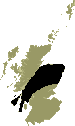
The Grampian Highlands – Argyll region, is underlain by deformed and metamorphosed rocks. Known as the Dalradian Supergroup, these rocks represent what was originally a very thick pile of marine sedimentary and volcanic rocks.
Underlying more of the Scottish landscape than any other group of rocks, the Dalradian Supergoup is long established as classic area for the study of rock metamorphism (alteration by intense heat and pressure) and deformation arising from ‘mountain building’, caused by continental collision.
Confined to the area defined by the Great Glen Fault to the NW and by the Highland Boundary Fault to the SE, the Dalradian sediments and volcanics were originally laid down, or in the case of the volcanics erupted onto, the southern margin of a continent known by geologists as Laurasia. This happened during the Precambrian and Cambrian periods between 700 and 600 million (and very possibly as recent as 500 million) years ago. In late Cambrian and through Ordovician times, the Dalradian Supergroup underwent deformation and metamorphism as Laurentia and a northern European continental landmass comprising England and Scandinavia collided, with the closure of an intervening ocean geologists call Iapetus.