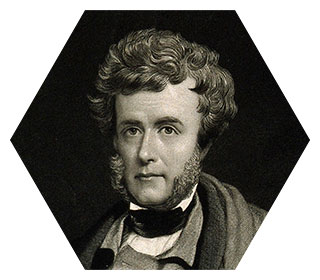
Hugh Miller 1802 – 1856
Hugh Miller was a self-taught stonemason and writer who became intensely fascinated by the fossils such as ammonites and fish he found near his home in Cromarty on the Black Isle. He moved to Edinburgh to become editor of The Witness newspaper and, being a staunch Christian, helped to found the Free Church of Scotland. His study of fossils, especially of the fossil fishes of the Old Red Sandstone (Devonian), led to his writing of (among others) three best-selling books: The Old Red Sandstone; Footprints of the Creator; and Testimony of the Rocks, in which he successfully popularised the science of geology. His studies brought him into the early debates about evolution (before Darwin’s theory of evolution), which he opposed on religious as well as scientific grounds.
He found over 6000 fossils, many of which form the core collection of Scottish fossils at the National Museums of Scotland in Edinburgh.
Miller was an active collector of local folk stories and traditions, which he saw as precious cultural “fossils”. Many of these would now be lost without him. His 1835 book Scenes and Legends of the North of Scotland is still in print today, and local folklore even finds its way into his scientific writings. Miller was also an active campaigner against social injustice in his own time, using his position as editor of The Witness newspaper to attack abuses of power and neglect of the poor wherever he saw them. The campaign for religious liberty in Scotland occupied much of his time in the late 1830s and early 1840s, closely followed by his blistering attacks on the Highland Clearances, the unsanitary living and working conditions of rural labourers and the urban poor, slavery in North America, and tyrannical behaviour by governments at home and abroad. He was also involved in arguments for the ‘right to roam’ and associated land access rights, which geologists have long benefitted from.
Miller’s position in Victorian debates about race and slavery has been controversial in recent years. For more information on research and scrutiny of these points, see issues 46, 48 and 50 of Hugh’s News (the magazine of The Friends of Hugh Miller).
For further information on Hugh Miller:
Visit The Friends of Hugh Miller and Hugh Miller’s Birthplace Cottage & Museum (run by the National Trust for Scotland).